

Every shop needs a flash unit. They’re a useful tool — flashing or gelling ink, curing ink and warming up that grilled cheese you’ve been looking forward to eating for lunch. A flash dryer isn’t a one-size-fits-all piece of equipment, though. Depending on the size and needs of your shop and plug type, you’ll look for different features in a flash dryer. Do you print large prints? Do you want to print water-based ink? These questions are important when considering which flash unit to purchase. Let’s talk about the differences between the four flash units, and how each serves a different shop.

PLUG TYPE MATTERS
The flash unit you get depends on the voltage and amp of your plug. The average residential house can handle 120 volts and 15 amps. If you’re printing out of a room in your house, you’ll need to make sure that you get a flash dryer with the correct plug. If you’re not sure about the plugs in your house, check with your electrician.
One way to get around this is to run an extension cord from a higher-voltage outlet to the room you’re printing and flashing out of. This isn’t always a perfect solution. You might not have an extension cord long enough or might not have a higher voltage plug in your garage or shop.
Don’t get an adapter for your plug. It might seem like this will work, but you can melt the plug or even start a fire. Make sure that the flash dryer you’re using works with the plug type you have available.
PRINTING STANDARD-SIZED PRINTS
Printing block letters, left chest prints, or 8” back designs? For printers learning the ropes of screen printing, check out the RileyFlash 16”X16” flash dryer.
This little flash is the perfect starter flash for printers learning the ropes of screen printing. It’s got a 10-foot power cord, wheels, and casters, so you can move it around your shop to establish the best flow for you. This flash unit warms up in about 10-15 minutes. While it doesn’t have an indicator light or an on/off switch, you can tell if it’s on or off by feeling if heat is emitting from the flash. You can always use a heavy-duty power strip as an on/off switch.
Plastisol ink is a great ink for novice printers to start with. It’s vibrant and doesn’t dry in the screen, so you can test, check your results, and go back to the screen without worrying about removing the ink in between. The 16”x16” flash unit works best with plastisol ink. It’s the perfect flashing and curing device for printers learning the ropes.

RELATED: DO DIY PRINTERS NEED A FLASH DRYER? SALT & PINE CO. SHARES HER EXPERIENCE
Printing larger plastisol designs? Let’s look at the RileyFlash 18”x18” flash unit.
PRINTING LARGER DESIGNS
An 18’X18” flash unit has a larger surface area, so you can gel or cure larger prints than you could with the 16”X16”. A larger heating surface means that the flash unit needs a beefier support system, and you’ll need more space to maneuver it around your shop.
This flash is great for a garage shop. It can be used in residential areas, but requires a 20 amp circuit. You can find this circuit at a local hardware store or online. A typical household has a 120V outlet rated at 15 amps. Check with your electrician if you have questions about your power lines and power outlets.
The 18”X18” flash unit will work great with standard-sized prints. If you’re going bigger, you might need a larger flash.
RELATED: HOW TO PROPERLY CURE PLASTISOL INK WITH A FLASH DRYER

OVERSIZED PRINTS
Imagine this for a second: you’ve been turning oversized print orders away because you don’t have the large flash capacity to handle them. The flash dryer you have is adequate, but the “sweet spot” of the heating element doesn’t cover an entire large print. Sound familiar? Meet the answer to your troubles: the RileyFlash 18x24.
This flash dryer can handle oversized prints without trouble. It also boasts 3233 watts of power and a tilt control knob so you can adjust the height of the flash easily. Best of all, the RileyFlash 1824 has an adjustable temperature control so you can dial in your flash and/or cure temperatures.
If you’re printing out of residential space—i.e a house or garage—take a look at your outlets before you jump in with this flash. The 18”X24” flash is 240 volts, which doesn’t come standard in most homes. Check with your electrician if you’re not sure about your home.
QUICKER PRODUCTION WITH QUARTZ FLASH DRYERS

When your shop starts moving from small, local orders to high-volume production or automation, every second on the press counts. If you’re finding that your traditional infrared unit is slowing down your workflow, it might be time to look at Riley Flash Quartz Dryers. These professional-grade flash cure units are engineered for speed, consistency, and precision, making them an excellent fit for automatic presses and high-volume manual environments.
The core difference lies in the heating technology. While infrared units take time to reach temperature, quartz tube technology delivers rapid on-off responsiveness. A quartz flash can reach curing temperature in under a second, which significantly reduces wait times and allows for quicker cycle speeds on your press. This means you aren't just standing around waiting for a flash to warm up, you are pushing more shirts per hour and keeping your momentum high.
Energy efficiency is another major benefit of making the switch. Because of the fast on-off cycling, Riley Flash Quartz Dryers consume less energy overall, especially in setups where the flash is idle between prints. This precision also translates to better heat control, which is critical when you are printing on delicate fabrics or thinner substrates that can be easily scorched by traditional IR units.
Beyond the technical specs, these units are designed to improve your shop environment. Since quartz units cool rapidly when they aren't in use, they release less ambient heat, contributing to a more comfortable shop climate during long production runs. The 18”x18” Riley Flash Quartz Dryer features dual-zone power control, allowing you to control heating zones independently to match the size of your design. The 18"x24" Riley Flash Quartz Dryer has even more control and a larger heat area for maximum production output and efficiency.
Whether you choose the 18"x18" model or the larger 18"x24", you’re getting a unit built with locking casters and a grab handle for easy relocation around your shop. These units are proudly made in the USA and come with a limited lifetime dryer warranty, ensuring your shop stays at full throttle for years to come.
RELATED: WHY QUARTZ FLASH DRYERS ARE THE SMART UPGRADE
So we’ve covered small, medium and large shops. But there’s one more awesome flash unit option to consider.

WATER-BASED PRINTING
Do you print with water-based ink? Finding that your gel/cure times are way longer than they should be? Check out the RileyFlash Forced Air. This flash unit is perfect for water-based shops.
To properly flash and cure water-based ink, you need hot airflow. With the Riley Flash Forced Air flash dryer, you’ll get it. The flash has both an infrared and an air dryer, so it pushes hot air evenly across the print, evaporating the water. The flash also has a blower in the back of the dryer, providing a steady stream of air throughout the t-shirt.
Let’s talk specs for a second. This flash unit is best used in commercial settings because its a 240-volt plug. The heating element is 18”X18” and boasts a whopping 4000 watts. The flash dryer also has an on/off switch and a temperature control knob. Printing with water-based ink just got that much easier.
RELATED: HOW TO START WATER-BASED PRINTING
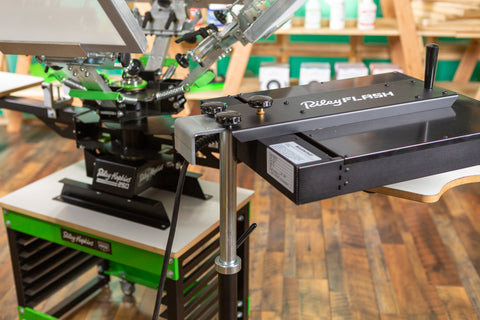
There’s a perfect flash dryer for every shop. No matter which flash dryer you use, make sure to test out your flash and cure temperatures and times, so you can get the most from your flash unit. Don’t sell yourself or your prints short. Get the right flash unit for your shop.